Each woman’s experience is of perimenopause different. Some get ‘classical’ hot flushes or night sweats, but many women get non-specific symptoms such as muscle aches; anxiety; palpitations; migraines; poor sleep; weight gain; hair loss; skin crawling. The list goes on and on…. All these changes can be quite subtle at the beginning, especially if you continue to have your normal periods. It may not be obvious that they are connected to perimenopause, and often results in misdiagnosis.
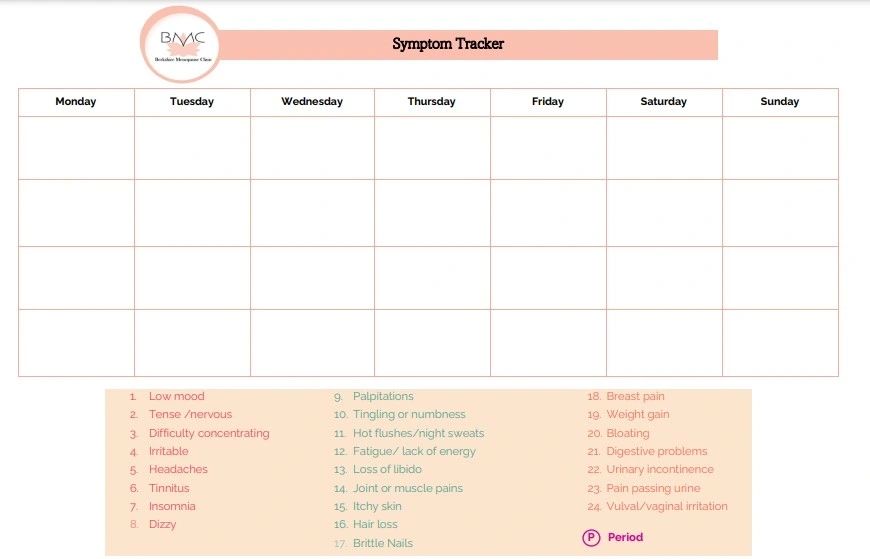
Keep a diary
You might find it helpful to track your symptoms in a diary (see picture) as this may identify emerging patterns that you can show your doctor.
Do I need blood tests?
Symptoms alone are usually diagnostic, and blood tests are often inaccurate due to fluctuating hormones. For this reason, we do not recommend blood tests especially over the age of 45. Occasionally, blood tests may be advised. For example, in those under age 45 if there is uncertainty of the diagnosis. This is because in these women, HRT significantly reduces risks of long-term health conditions such as osteoporosis and heart disease and so it is important not to miss the diagnosis and opportunity for disease-prevention treatments. Occasionally, other conditions (such as thyroid disease) present similarly to perimenopause, and blood tests may also be valuable in these cases.
You do not need to wait for your periods to stop to begin treatment!
Treatments include physical and psychotherapies, non-hormonal medications, and Hormone replacement therapy (HRT). Perimenopause is not a ‘one size fits all’, Your doctor can help guide you through options that are safe and right for you. You are not alone!- If you are concerned your symptoms may be related to perimenopause or menopause, please seek help.