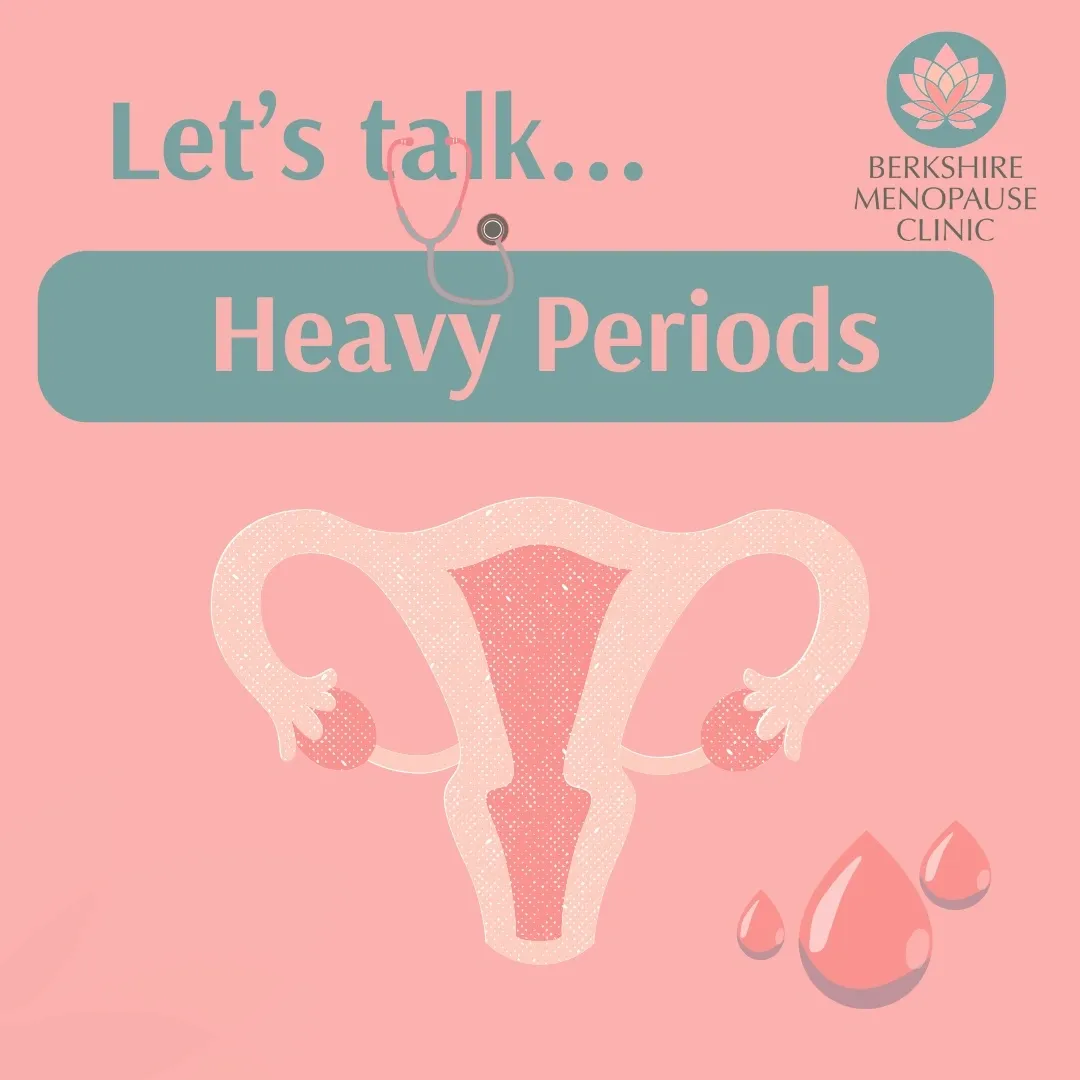
Heavy periods or ‘Heavy menstrual bleed’ or ‘menorrhagia’
The definition of heavy periods is to have heavy bleeding (around 80ml or more) during your monthly menstrual cycle (period). For many women, heavy periods are accompanied by pain (dysmenorrhoea).
It is difficult to measure heavy bleeding and there are criteria for formal diagnosis.
However, everyone is unique and how we manage periods should be based on how it affects each individual and your quality of life.
What are the criteria for formal diagnosis:
· You are needing to change pads or tampons every 1-2 hours due to soaking
· You are bleeding through to your clothes or bedding
· You need to use 2 types of sanitary products together due to leaking
· You are passing clots bigger than 2.5 cm (approximately the size of a 10p coin)
· You are feeling breathless or tired frequently
· They are affecting your quality of life, causing you to miss activities, sport, or work
· Your periods last more than 7 days
What causes heavy periods?
For many women, heavy periods are common, and the cause is often unknown. Commonly they can occur when you first start your periods, after pregnancy, or around perimenopause, often triggered by hormonal changes.
Other conditions increasing heavy bleeding include fibroids, endometriosis and adenomyosis. In some cases, you may get heavy periods often accompanied by bleeding between periods- this includes female genital tract infections, womb polyps or cervical polyps, and very rarely precancerous or cancerous changes to cervix and womb.
Less commonly clotting disorders and thyroid disease can cause changes to your periods. The side effect of medications such as Warfarin can be heavy bleeding.
Do I need any tests?
Heavy periods without any bleeding between is often hormone related, and a trial of hormones without investigation is usually advised in the first instance. If despite this, you continue to get heavy periods with or without bleeding between your periods, then your doctor may arrange examination, swabs and an ultrasound of your womb. Depending on these results, you may need to be referred to a gynaecologist for further tests. It is also important you keep up to date with your cervical screening tests.
If you are displaying additional symptoms or signs that may suggest thyroid or clotting disorders, then blood tests to rule these out may be warranted.
If you are feeling breathless or tired frequently, this may be a sign you are anaemic (needing iron replacement) and performing a blood test to look at your iron profile may be helpful to diagnose this.
What are the treatments for heavy periods ?
Heavy periods do not always need treating, and management should be based on how they are affecting your quality of life. Whatever you choose to do, it is important you feel supported.
You may choose to observe your symptoms; You may have accompanying symptoms such as dysmenorrhoea (painful periods), which may influence your need for treatment; You may have already tried some treatment or been diagnosed with a condition that needs specific treatment.
Keeping a diary
Keeping a diary (over several cycles) of symptoms, bleeding pattern, flooding/interruption of normal activities, and previous treatments may help you and your doctor assess how bad symptoms are and formulate a plan personalised for your specific needs. It can also be a useful way of monitoring how well new treatments are working.
Lifestyle
You may find making some lifestyle changes can help improve symptoms, particularly if the cause is due to inflammatory conditions such as endometriosis.
Such measures include stress reduction, getting plenty of sleep, and trying a low inflammatory diet.
You may find these links helpful for lifestyle and nutrition tips:
https://www.theendometriosisfoundation.org/diet-and-lifestyle
https://womens-healthcare.co.uk/anti-inflammatory-endometriosis-diet-foods-to-eat-and-avoid
Non-hormonal medications
These are taken on the days of heavy bleeding. These types of medicines are not contraceptives, so it is important you take additional contraceptive measures if you are not wanting to get pregnant. .
Tranexamic acid
This works by reducing the breakdown of blood clots in the womb, which reduces the heaviness of bleeding. However, it does not reduce the number of bleeding days. It is normally taken for 3-4 times a day when bleeding is heavy. Side-effects may include an upset stomach. If you have had a history of clots in your legs or lungs, or have a strong risk for a clotting condition, then this may not be a suitable option.
Anti-inflammatories
These are used to help alleviate pain that occurs with periods. In many women, they can also reduce the heaviness of bleeding. They work by reducing prostaglandins in the lining of the uterus which can cause inflammation and heavy bleeding. You can buy these from the pharmacy. Examples include Ibuprofen and naproxen. Mefenamic acid is another anti-inflammatory which is available on prescription. It is usually taken three times a day for the duration of your period.
Side-effects include an upset stomach. They are not usually advised in those who have had a history of a duodenal or stomach ulcer, or asthma.
Many women take both mefenamic acid and tranexamic acid for a few days over each period as the combination can be effective when having both painful, and heavy periods.
Hormonal medications
Combined oral contraceptive pills (COCP)
These contain the hormones oestrogen and a progestogen combined in the same table. These work by preventing ovulation (an egg being released by the ovaries) and are a form of contraception. They are also a good option for painful periods. They can be taken every day with no breaks to help prevent bleeding or can be taken with a 3-7 day break every month. In this latter case, you are likely to still get a withdrawal bleed, but the aim is to reduce the heaviness. Bleeding tends to be predictable with this tablet. However, there are some cases where this option may not be suitable. For examples in those with a history of blood clots (thrombosis) or stroke, migraines with aura, hormone receptor cancers. It is important to consult your doctor before taking this. Side effects may include breast tenderness, nausea, mood changes and headaches. There are different types of COCP. If you have experienced side effects from one type, this does not mean they will all give you these effects, and there may be different options that suit you much better.
The progesterone only pill (POP)
This is also a type of contraceptive pill. It works by preventing ovulation and the growth of the womb lining. This is a good option in those for whom a combined pill is not suitable. Bleeding with these tablets may be less predictable than with the COCP, with one side effect possibility being irregular periods. Other side effects include bloating, breast tenderness and headaches.
Medroxyprogesterone (Provera) and Norethisterone tablets
These are progestogen tablets that you take for a short period of time; cyclically; or every day and tend to be used to temporarily reduce heavy bleeding. They are also not used as contraceptives.
Progestogen Implant
This is a small plastic rod that sits under the skin in the inner upper arm and slowly releases progestogen (Etonogestrel) over 3 years. It is mainly used for contraception by stopping the ovaries from releasing an egg (ovulation), thinning the womb lining, and thickening the mucus in the cervix to stop sperm reaching an egg to fertilise it. By reducing ovulation and thinning the womb lining, bleeding can become either very light or stops altogether within 3-6 months of starting this treatment, and therefore is an option for heavy periods. However, one main side effect is irregular and unpredictable bleeding especially whilst the hormones are settling in the first 3-6 months. If you feel this side effect is unacceptable for you, even in the initial period, then this may not be a suitable option.
Depot injection (Medroxyprogesterone)
This is an injection, usually administered in the buttock, that delivers progestogen hormone, lasting up to 3 months. It is mainly used for contraception by stopping the ovaries from releasing an egg (ovulation) and thickening the mucus in the cervix to stop sperm reaching an egg to fertilise it. By reducing ovulation, bleeding can become either very light or stops altogether, and therefore is an option for heavy periods. They are also a good option for painful periods, in particular that associated with conditions such as endometriosis. The main side effects are weight gain, irregular bleeding, premenstrual symptom, and delayed return of fertility. Less commonly, there is risk of osteoporosis (brittle bones) and therefore this option is not advised long term or in those vulnerable to osteoporosis (such as those already with osteoporosis or osteopenia, post-menopausal women, or young girls whose bones are not yet fully developed).
Levonorgestrel intrauterine system (LNG-IUS)
One example brand is a Mirena coil fitting. This is a small plastic T-shaped device that sits in the womb and directly releases a steady amount of progestogen to keep the womb lining thin. As a result, for most women, bleeding becomes either very light or stops altogether after 3-6 months of starting this treatment. They are also a good option for painful periods and are a first line treatment option for conditions such as endometriosis. Furthermore, they are used as a highly effective form of contraception, and the progestogen part of HRT. Depending on the reason for use, it is replaced every 5-8 years.
One side effect is initial erratic or heavy bleeding whilst the hormones settle in the first 3-6 months. If you feel this side effect is unacceptable for you, even in the initial period, then this may not be a suitable option.
Other treatments
If there is a specific cause to your bleeding or your bleeding is not helped by any of the initial treatments, then you may wish to see a gynaecologist for investigations or more specialist medical or surgical treatment options. The types of treatments offered will depend on the cause of your heavy or painful bleeding.
Gonadotrophin Releasing Hormones (GnRH analogues)
These are medications that chemically ‘switching off’ the ovaries, which then stops periods. The treatment is usually given via injection either monthly or every 3 months.
The main side effect of GnRH analogues is the development of menopause symptoms due to reduction of oestrogen that occurs by switching off the ovaries. Blood sugar levels may be also altered during treatment. If you are diabetic, you may require more frequent monitoring of blood glucose.
You can also experience bleeding irregularity and bone density loss (a risk for brittle bones and osteoporosis). If you continue this treatment long term (more than 6 months), it is advised to have to use HRT alongside this for reducing menopause symptoms and to prevent osteoporosis. It is also recommended to have a bone density scan every 2 years of continuing use. At 2 years, we would advise a 6-month break from treatment.
Endometrial ablation or resection
This is a procedure to remove the lining of your uterus using heat, laser, radio waves or freezing. It is done under anaesthetic: either regional (for example spinal anaesthetic) or general (being asleep).
To maximise the chance of removing all the womb lining successfully, it is not suitable in those where heavy periods is due to large fibroids or polyps obscuring the womb lining.
If you wish to get pregnant, you should not have this procedure done. Although pregnancy is rare, an ablation does not always prevent pregnancy and is not a form of contraception.
Specific treatments for fibroids causing heavy periods
Treatment options depend on the size, location, and number of fibroids; severity of bleeding; as well as other symptoms that occur such as pressure symptoms resulting from large fibroids pressing on bladder, bowels and other pelvic organs.
Example treatments include myomectomy (fibroid removal) and Uterine Artery Embolisation (UAE), which involves blocking the blood supply to the fibroids causing them to shrink.
Hysterectomy
This is major surgery to remove the womb, where your periods will stop permanently. This may be a total hysterectomy (removal of the womb and the cervix-the neck of the womb) or subtotal (removal of the womb only). You may be offered to have your ovaries removed, depending on your symptoms and the reason for the hysterectomy. If this is an option you are considering, the potential risks and benefits should be fully discussed with you.
For more support, book an appointment with our gynaecology, menopause and women’s health specialist